Why Mentorship Is the Next Frontier in Skills-Based Volunteering
Skills-based volunteering (SBV) has evolved from a “nice-to-have” into a strategic driver of corporate purpose. Operational data confirms the shift:...

2 min read
Chris Motley
:
Dec 10, 2025 7:22:00 AM
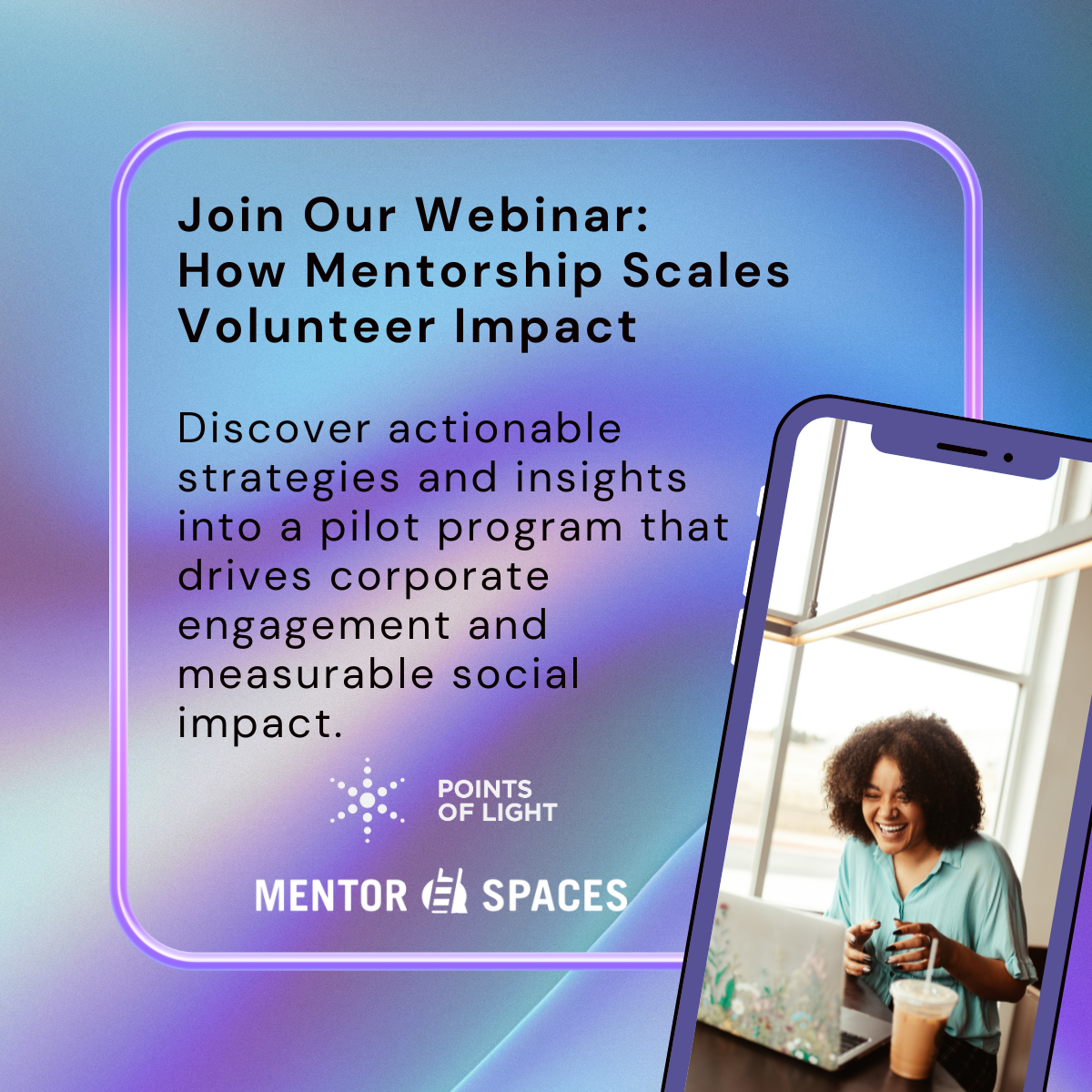
For years, corporate volunteering has centered on hands-on service and one-day events. But the workforce has shifted. Employee expectations have evolved. And according to Points of Light, volunteerism itself must double by 2035 to meet community needs. Mentorship is one of the only scalable, high-impact levers that can get us there.
During our recent webinar with Points of Light, Senior VP Lacey Gaitan captured it perfectly: "Mentorship is not just about giving advice. It's about transferring opportunity."
That framing marks a turning point. Mentorship is moving from "nice to have" to necessary infrastructure for how companies engage talent, advance equity, and meet their CSR goals.
Traditional volunteering excludes a massive percentage of willing employees—especially busy professionals, caregivers, hybrid workers, and people without geographic flexibility. Meanwhile, 22% of young people seeking a mentor are already on waitlists. Career services teams are under-resourced. Nonprofits supporting mentorship are overextended.
And here's the equity gap: the majority of college students graduate without a single industry connection. For first-generation students and those from underrepresented backgrounds, that number rises to nearly 80%. This isn't a talent issue. It's an access issue.
Mentorship unlocks participation from the very people students most need access to: industry experts, mid-career professionals, and emerging leaders who might never join a traditional hands-on project. As Points of Light emphasized, these professionals can now contribute meaningfully from anywhere—and at scale.
This is the future of skills-based volunteering: accessible, flexible, virtual, and measurable. And it deepens—not replaces—existing community partnerships.
We're facing a convergence of urgency that traditional CSR programs simply cannot address:
As Lacey shared, supportive relationships directly build resilience, confidence, and lifelong skills. Yet our current systems leave the vast majority of students without access to those relationships. Talent is everywhere. Opportunity is not.
Companies are uniquely positioned to close this gap—and mentorship is the most direct path. Through platforms built for scale, corporate mentorship delivers:
For companies:
For employees:
For communities:
The data is clear. Cross-class connections are the strongest predictor of economic mobility ever identified. Corporate mentorship creates these connections at scale while simultaneously expanding your volunteer pipeline, meeting workforce-equity goals, and delivering measurable outcomes through the systems you already use.
This is not soft ROI. This is strategic infrastructure for the future of corporate social responsibility.
Mentorship isn't an "extra." It's a strategic shift toward equitable access, measurable outcomes, and a wider volunteer pipeline that meets the moment we're in.
Corporate mentorship closes the access gap—and accelerates your ability to meet both volunteerism and workforce-equity goals.
Mentorship is no longer nice. It's necessary.
Watch the webinar replay here: https://mentorspaces.com/points-of-light-webinar
Skills-based volunteering (SBV) has evolved from a “nice-to-have” into a strategic driver of corporate purpose. Operational data confirms the shift:...

The future of corporate social responsibility isn’t about counting hours. It’s about proving outcomes.
Corporate social impact is undergoing a major transformation.