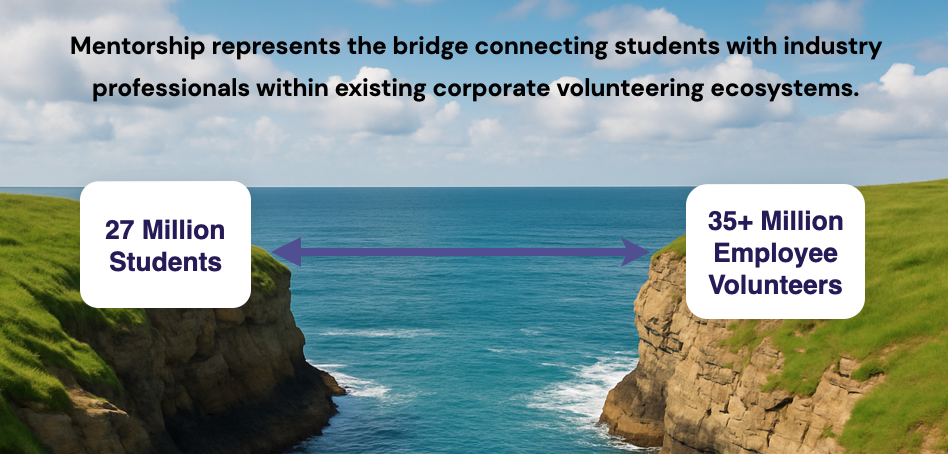
Bridging the Network Gap: How Companies Can Help 27 Million Students Cross the Opportunity Divide
There are approximately 20 million students enrolled in U.S. postsecondary programs, and an additional 7 million individuals are high school juniors...

2 min read
Ryan Stoner
:
Jan 14, 2026 7:18:00 AM
What do a world-class psychologist, a MacArthur-level academic mentor, and the NBA's top shooting coach have in common?
They all practice the same set of mentoring behaviors—behaviors that every manager, people leader, and skills-based volunteer can use to unlock growth in others.
During our Points of Light webinar, Dr. David Yeager described this as the mentor mindset: a combination of high standards and high support that empowers people to develop long-term confidence, agency, and skill. And the habits behind it are surprisingly simple.
When we jump straight to giving advice, we rob the mentee of the chance to think critically, articulate barriers, or take ownership of their growth. It may feel efficient in the moment, but it decreases long-term capacity.
Transitions—first job, new role, stretch project—are when people experience the most doubt. Psychologists call this belonging uncertainty, and it's one of the biggest threats to early-career success. Without the right support, "I'm struggling" becomes "I'm failing" becomes "I don't belong here."
Traditional management training doesn't solve this. It teaches leaders what to do, not how to build independent, confident thinkers who can perform without constant oversight.
According to Dr. Yeager, 80–90% of what the best mentors do is ask questions, not lecture.
The alternative to advice-giving is collaborative troubleshooting:
These questions transform challenges from threats into evidence of growth. They help employees interpret setbacks as normal, temporary, actionable, and part of the learning process. They turn "I'm failing" into "I'm learning."
Managers can use this every day—in 1:1s, project debriefs, onboarding, and performance conversations.
Here's the paradox: organizations want people managers who coach rather than fix, delegate confidently, and build independent teams. But they rarely have structured ways to develop these capabilities.
Leadership training is often theoretical. Performance reviews come too late. And most managers never get the reps they need to practice teaching complex skills or communicating with clarity under pressure.
Meanwhile, employees—especially early-career talent—are left to navigate critical transitions without the frameworks they need to succeed.
Dr. Yeager shared the story of Chip Engelland, the elite shooting coach behind the San Antonio Spurs and now the Oklahoma City Thunder. In just three years, OKC went from the NBA's worst shooting team to the best—and won a championship.
Chip's secret? He doesn't overwhelm players with technical corrections. He builds their internal decision-making.
In each session, he asks:
The goal is to install a coach in their head—a mental model they can use during all the hours Chip isn't with them.
Leaders can apply this same approach: give people a thinking framework, not just answers. Build their capacity to solve problems independently. Create conditions where growth continues long after the conversation ends.
One of Dr. Yeager's most powerful insights: mentorship develops the mentor. Through repeated reps, leaders learn to:
These are the exact skills organizations want in people managers—and skills-based mentoring gives leaders a safe place to practice them.
As Dr. Yeager put it: "You don't want them to only get better while you're still talking to them."
A mentor with high standards and high support helps people grow faster, stay engaged longer, and build confidence that lasts well beyond the mentoring moment.
That's the mindset companies need—in their volunteering programs, in their leadership pipelines, and in every manager-employee relationship.
The mentor mindset isn't just for mentors. It's for every leader who wants to build capacity, not dependency.
For further insights, please watch the Mentor Spaces webinar with Points of Light and David Yeager.
There are approximately 20 million students enrolled in U.S. postsecondary programs, and an additional 7 million individuals are high school juniors...
For years, corporate volunteering has centered on hands-on service and one-day events. But the workforce has shifted. Employee expectations have...
The future of corporate social responsibility isn’t about counting hours. It’s about proving outcomes.